Petty’s Plus Irrigation, Landscape, Pest Control, Lawn & Shrub Treatment
We are the protectors of your property!
Petty’s Plus has been serving East Texas for more than 70 years, developing a reputation for quality service.
Whether your irrigation system needs a simple tune-up, or your landscape needs a complete renovation, Petty’s Plus will perform all the services you expect and deliver more.
75 Years in Business!
About Petty's Plus
How can I be sure I will get a good quality system?
Yes, irrigation systems are directly connected to your city water supply. The system must meet local codes for attachment to the potable water system. Irrigation in Texas is regulated by the Texas Commission on Environmental Quality(TCEQ) and Petty’s Plus maintains all of the appropriate licenses.
Does my installation contractor have to be licensed?
Yes, irrigation systems are directly connected to your city water supply. The system must meet local codes for attachment to the potable water system. Irrigation in Texas is regulated by the Texas Commission on Environmental Quality(TCEQ) and Petty’s maintains all of the appropriate licenses.
How do you determine what water pressure to use in the design of my system?
Piping hydraulics must be considered to ensure the proper operation of your sprinkler system and must be based on a correct measurement of the available water pressure and volume. Your installer will take into account your planned watering schedule and projected changes in water pressure in your neighborhood. On larger properties, the installer may recommend increasing the size of the water meter. Savings on extra valves and piping may offset the cost of installing such a larger meter, but if the governing utility in your area will not permit you to install a larger meter, your system can be designed with the existing meter.
How deep should the pipe be installed? What kind of pipe will be used? Will it be laid in trenches or “pulled” into the ground?
Lateral piping should be as deep as the height of an assembled sprinkler head and Headsaver® swing joint. This is usually a minimum of 6 to 8 inches. Main-line pipes should be 8 to 10 inches deep. Excessive depth makes repairs difficult, while extremely shallow installation may interfere with turf maintenance and result in damage to pipes or wiring. Two types of pipes are in common use: Polyvinylchloride (PVC) and Polyethylene (PE). Both are serviceable, but whichever is used, it should be clearly marked as approved by the National Sanitation Foundation (NSF). Both trenching and “pulling” are acceptable methods of installation depending on soil type and conditions.
Why Us
When you need to enhance your property or maintain your investment, Petty’s Plus provides you with expertise and knowledge to give you the peace of mind that the job will be done right, and your satisfaction is guaranteed.
From Our Clients
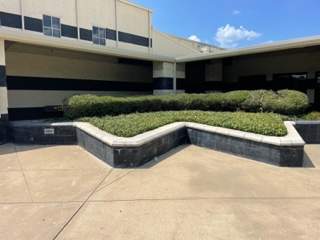
“Petty’s Plus has been an integral part of many HGR projects, but one that is most prominent within our portfolio is the Tyler Junior College Nursing Building. Their talent, expertise, quality control, and dedicated team on this project was paramount; but most importantly, with any Petty’s Plus project, one of the most important aspects of their partnership is always fulfilling their warranty obligations!
R.R., HGR Construction
TJC Nursing
“Petty’s Plus has been an integral part of many HGR projects, but one that is most prominent within our portfolio is the Tyler Junior College Nursing Building. Their talent, expertise, quality control, and dedicated team on this project was paramount; but most importantly, with any Petty’s Plus project, one of the most important aspects of their partnership is always fulfilling their warranty obligations!